
This Must Be the Island is a maximalist book: rich, full, generous and open-ended. It is both an art book and a book about how the art it contains was planned and organised over more than 15 years and across various locations. At the heart of it is a series of beautiful zinc plate etchings made by artist-poets Gregory O’Brien and John Pule from 2010 onwards, soon after O’Brien co-curated a show of Pule’s work at the City Gallery in Wellington. You need to linger a while and look into these. The early etchings are quiet, mysterious, esoteric and even dreamlike. The images are formed from spidery white lines, with trees and plant life, bird-man creatures and poetic phrases emerging from a mythic zone of the artists’ own devising, set against a deep black-purple background. You can imagine that dark background is the night sky, which is implied in a work titled ‘Star Navigators’, produced after the pair joined an artists’ trip to the Kermadec Islands in 2011. As Pule says, they had to start in the dark, before ‘moving gradually to paradise’.
Some of the works then appeared in a touring exhibition, Kermadec: Nine Artists in the South Pacific, and a subsequent book. Yet the collaboration between O’Brien and Pule continued. Their friendship also had history, dating back to early 80s poetry nights at the Globe pub in Auckland, a scene that has taken on legendary status (see also: David Mitchell, Bob Orr). But there is a way in which their artistic relationship, ignited by the City Gallery period, never entirely shakes off the dynamic of curator and artist, or organiser and creator. They loosely remain in these roles. As the book unfolds, you get a sense of O’Brien as one of the New Zealand arts scene’s great facilitators or instigators. He has connections to funders, publishers and institutions; he is one of the people our arts sector has relied on (and needs) to make things happen. O’Brien communicates this work to the world, through articles and lectures. The relationship might look imbalanced, with O’Brien directing and Pule responding, but it is Pule who is the wellspring of creativity. He shows O’Brien how to ‘soak up the oceanic ambience’. In an opening poem, ‘Great World’, Pule writes that ‘the sea is an enormous giant in my blood … Polynesia is the great Vā’. Pule’s work on the facing page, ‘Kavaka’, finds two humans dwarfed by huge biomorphic forms that could be kelp swaying in a vast ocean. The book then becomes a map of the Pacific or a record of journeys as far as Rapa Nui and Chile. As Pule says, citing pioneering Tongan-Fijian anthropologist Epeli Hau’ofa, ‘the ocean defines and shapes who we are, our cultures, how we see the world, how we relate to each other … The ocean belongs to all of us, not to one single country’.
As well as the works themselves, the book gives us the material that surrounds their creation. This is where maximalism comes in. There are journal pages from both artists, which are like demos tacked onto a finished album. Interesting but not essential, in other words. There is poetry from both men, which also seems less impactful or is at least not fully integrated with the art. Perhaps a separate section of poetry might have worked better than scattering the poems through the book. There are travel photos, and then there are the emails that go back and forth, which also act as a way to record the passing of time: O’Brien writes from Wellington after the Kaikoura earthquake in 2016 (‘Pretty unnerving’); Pule writes about the house he is building on Niue; they both comment on the HMNZS Manawanui’s accident in Samoa in 2024, when 200,000 litres of diesel leaked into the ocean.
There is something nicely disruptive about these real-world moments crashing into the semi-imaginary Pacific the pair have created. O’Brien has explained that the book’s title was informed by that idea of a semi-imaginary Pacific, with the book as the island they have been trying to reach. Islands are both actual landmasses and internal states. In an interview, O’Brien talks about the visionaries who first inspired them in the 80s: the Romantics, Rimbaud, Blake, Bob Dylan. They talk about Pablo Neruda on Rapa Nui (he called it the separate rose). O’Brien reminisces about the French poet Yves Bonnefoy, whose poems he took all over the Pacific. The final island was Waiheke, where O’Brien and Pule met in 2025 and 2026 to put all this work together and look for ‘patterns and echoes’.
The profusion of material threatens to overwhelm the reader at first and the best advice would be to ease in slowly. You will also be grateful for a chronology that helps steer you through it and which also shows how much work came from these meetings and how fruitful it was, especially for O’Brien. This was a rare kind of collaboration. It was not a case of an artist illustrating words brought to them by a poet (think of Hotere and Manhire, or McCahon and Caselberg), but two versatile artist-poets of a similar age but from different backgrounds finessing the work together. O’Brien has more to learn, but he has a mystical sensibility and a thirst for knowledge. The book also illustrates the value of getting writers and artists out of their comfort zones. The Kermadec trip came about because O’Brien was working with a philanthropic organisation from the US that was keen to send artists on a frigate to Raoul Island and Tonga, alongside scientists and Department of Conservation workers (‘Plenty of room for some good talk,’ O’Brien wrote to Pule). Whether it is in Berlin or Menton, Antarctica or the Pacific, opportunities for this kind of exposure, and the fresh perspectives it offers, are invaluable to New Zealand’s arts community.
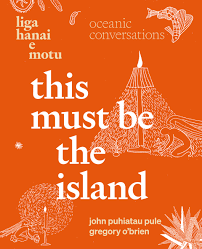
This Must Be the Island—Liga Hanai e Motu
by John Puhiatau Pule and Gregory O’Brien
ISBN:9781991309440
Published: November 2026
Format: Hardcover, 240 pages

