

With Kings of this World, Elizabeth Knox returns with something of a seismic boom to the young adult genre. The novel, centered around the lives and relationships of a bunch of very special high school students, is set in an imaginary yet often familiar southern land, bordered by sea, a sketched map of which is provided at the beginning of the book. I do love a book with a map – the roads and railways and labelled landmarks send an immediate signal that there will be journeys and adventures, while the rivers and peaks and inlets that make up the terrain promise to provide challenges along the way, or perhaps offer hideouts to heroes seeking protection from whatever antagonists may emerge.
The first location of the novel, known as The Crucible, is not marked on the map. But the cult-like closed community reappears frequently in the traumatic memories of Vix – Victoria Magdolen – the novel’s young heroine. In the prologue we learn something of the terrible event that has destroyed Vix’s family and childhood, making her both famous and a little feared by mainstream society. We also first encounter the Push, a mysterious mental capacity possessed by a small but significant percentage of the population, which enables them to exert influence over others in their presence. This ability to Push, which varies greatly in nature and strength from individual to individual, as well as the difficulties and possibilities that Pushing presents both for its possessors and wider society, gives the novel its central premise.
In the bleak opening passage, little Vix is the recipient of her father’s Push, although the circumstances and motivations that trigger the act of this ambiguous adult character remain shrouded in mystery for much of the book:
He bent closer and kissed her forehead. Then he said, ‘You want to sleep.’ He Pushed. His Push was so hard it was like he was shoving her underwater. But Vix’s consciousness was buoyant; the bubble of it slithered and slipped under his Push and bobbed to the surface, where it burst, because, in the short time she had been down in the darkness, the car doors had been shut and locked. The interior light was off and all she could see and hear was the seething tree. Her father had gone. He’d said, ‘Wait.’ Vix was sure he’d said ‘Wait’ before he went away.
The novel plunges the reader into the boarding school world of the now adolescent Vex, as she has renamed herself, and opens a few weeks after her arrival at the Tiebold Academy as she files into the morgue with her classmates to witness an autopsy. Many of these characters possess the familiar traits of a fictional group of teenage heroes and misfits: Taye is sensitive, vulnerable, but unexpectedly strong; Hannu is sporty, rich and rebellious; Ronnie is sensible and clever and loyal; and Ari is the moody, complex, beautiful boy with whom Vex senses her destiny is irrevocably linked. What happens in the morgue (and immediately afterwards) rapidly establishes the main externally driven conflict of the novel, and the circumstances in which each of the young characters will be called on to prove their mettle, and to find the strength and courage to survive the terrifying events that unfold.
At each stage of the ensuing action, Knox precisely describes the positions and movements of the characters. This is the student group boarding a minibus following the morgue incident:
Vex climbed into the minibus and went as far forward as she could, so she was right behind Helen, who was riding shotgun. Ari took the seat in the short row by the sliding door and laced his satchel on the other seat so that no one could sit beside him. Ronnie sat directly in front of him but kept peering at him over her shoulder. Taye and Hannu sat at the back.
This level of precision means readers can visualise scenes and follow the progression of events. However, the degree of narrative detail can distract as well as inhibit the story’s natural momentum. In this case, the seating plan proves immaterial, since the student passengers soon succumb to chloroform and are whisked away to the depths of a disused paper mill, where they are kept captive, tortured and humiliated by a band of sadistic and mysterious thugs.
Before we reach this dark and quite disturbing stage of the novel, the story’s forward impetus is interrupted again, taking us back five weeks in time. Vix/Vex is a cool and confident teen on her way to a new school. She is a rebel and a rule breaker, rides a motorbike, shoplifts silk shirt dresses from an upmarket boutique, favours ‘many-buckled biker boots’ over Tiebold Academy’s regulation school footwear, and wears her white school shirt ‘under her leather jacket, untucked and unbuttoned to her cleavage and diamante-studded bra.’ Despite her racy appearance, however, Vix is not a Bad Girl – demonstrated by her speedy dispatch of a drug dealer, whom she Pushes from a park.
In the town of Wry, Vex encounters Ari – son of high-profile Senator Mason – for the first time: he is attempting to save a man from committing suicide by Pushing him. The pair’s connection is instant, despite the silly irony in their adolescent banter, and the novel’s love interest is thus established. When they are interrogated by the police in the aftermath of the suicide attempt, the reader learns a great deal more about the Power of P.
As the dark adventure unfolds, the novel continues to zigzag between current story time, and recent and more distant past. This narrative timeline, which demands careful attention, releasing snippets of information though memories, conversations, media broadcasts and police or medical interviews. Slowly but surely, these fragments provide the reader with all they need to construct a final understanding of what exactly has been done by whom to who, and why.
Along the way, the characters grow in believability, complexity and individuality; each member of the student group has, along with their own unique relationship to the big P, very personal flaws, but also redeeming strengths. The respect, trust, and affection which gradually develops between them during the horrors of their imprisonment is very convincingly depicted, though Helen Scott, the employee of Ari’s father who is also caught up in the kidnapping and subsequent developments, emerges as an untrustworthy and complicated character, and our sympathy for her remains tenuous throughout.
The Really Bad Guys play their roles with gusto, in cinematic, suspenseful scenes that are visceral and genuinely scary. If they fail to emerge as very nuanced or comprehendible characters, this is hardly surprising: they remain masked and are known only by nicknames. To add to the creepy confusion of the prison basement, the kidnappers, as part of their systematic process of dehumanization, also elect to rename their captives:
‘Let’s tell them their names, and how it works,’ said the big one.
The chatty one strolled round the room jabbing the ends of each of their mattresses with his foot and naming them. Ari was Freak, Vex Toxin, Ronnie was Two Shoes. ‘Though,’ Chatty chuckled, we’ve taken your shoes. It’s short for Goody Two Shoes, sweetheart, because you’re the model student and the good girl.’ He kicked Hannu’s mattress. ‘You are Payday: I’m sure you can work that one out.’
He crossed to Helen and booted her foot rather than her mattress. ‘Grown-up,’ he said.
Taye muttered something.
‘Eh?’ said Chatty. Headcase,’ he added. He really seemed to enjoy saying it.
Alongside the suspense and adventure, Knox explores with some sensitivity the fraught emotional landscapes of teenage friendship, family politics, sexual awakening, and academic pressures. But it is Pushing, the unnatural gift that allows one to influence the thinking and behaviour of others in the Pusher’s presence, that remains the highly original cornerstone of the novel, and emerges almost as a character in its own right. The concept of this special ability – met with varying degrees of suspicion, envy and acceptance by society – suggests various real-world contemporary social concerns. Is neurodiversity to be regarded as a talent or a liability? Can – and should – exceptionalism be fostered, promoted, or harnessed for the wider social good?
The reaction of police officer Cameron to Ari depicts an alternative world in which significant difference might not be distrusted, but instead welcomed and valued, and where a policeman might have time and insight enough to spot potential:
Cameron pushed the paper across the table. ‘This is the name and number of a professor at the University of Castlereagh. I did his professional development course. He heads Castlereagh’s Crisis Management degree programme.’ He paused. ‘What year are you in at the academy?’
‘My final.’
He is going to be my classmate, Vex thought.
‘Whatever else you’re planning – this is what you should do,’ Cameron said. ‘Crisis Management. A gift like yours – you have a duty towards it. You have a duty towards the people you live among.’
Consent is another topical issue touched on in the novel, one of critical importance to contemporary teenagers. When it becomes clear that the physical relationship evolving between Vex and Ari will be intensely complicated by their exceptional P, the reader is offered an intriguing contemplation, less comical than similar imaginings in Hollywood settings, of the difficulties and dilemmas that would emerge in a world where the mere expressed wish that someone desire you, or surrender to your desire, would instantly propel that imagined reality into being.
Thomas Carlyle’s quote, which gives the book its title, states that ‘not brute force, but persuasion and faith are the kings of this world.’ Yet the crowns weigh heavy on the heads of this novel’s youthful persuaders, and their extraordinary abilities create as many problems as they do privileges. Darkness and light walk hand in hand across the pages of this book. Alongside the familiar literary tropes one anticipates in a coming-of-age adventure set in a boarding school steeped in supernatural talent, in Kings of this World Elizabeth Knox navigates, with impressive skill and sensitivity, some of the very real anxieties confronting the young adults who will, I feel certain, be her many avid readers.
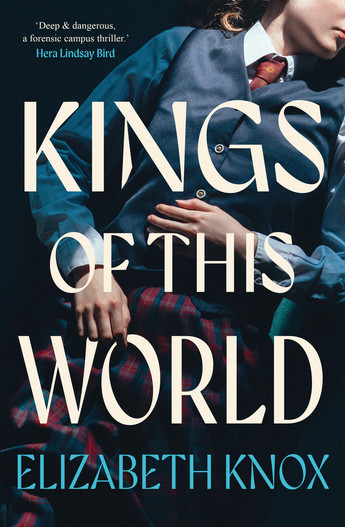
Kings of This World
by Elizabeth Knox
ISBN: 9781991142283
Published: September 2025
Format: Paperback, 336 pages

